

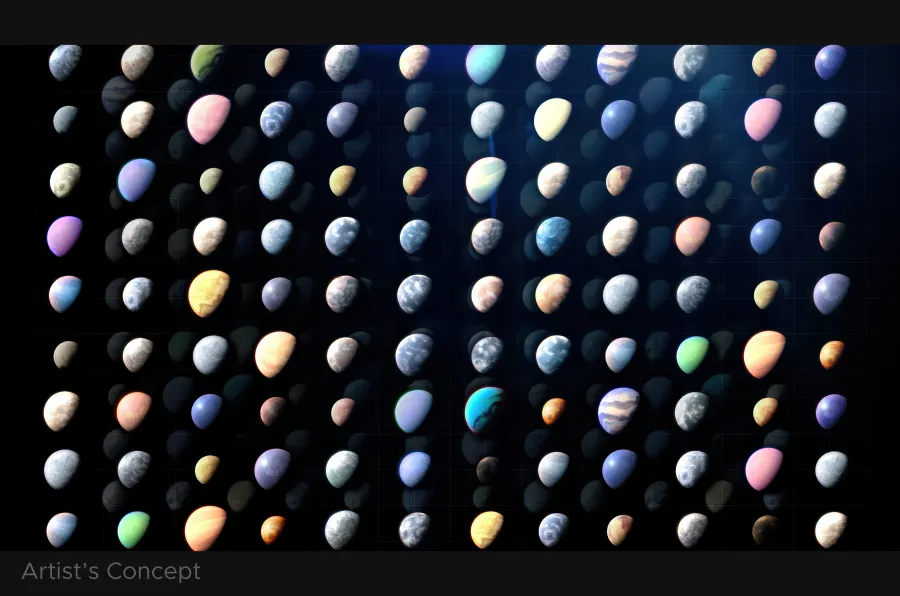
More than thirty years after the discovery of the first planet outside our solar system, NASA now tracks over 6,000 confirmed exoplanets. Scientists across the globe continue to verify new discoveries, with more than 8,000 additional candidates awaiting confirmation through NASA’s Exoplanet Science Institute (NExScI).
Why 6,000 Matters
Hitting the 6,000 mark isn’t about mapping a milestone planet — it’s about accelerating discovery. Each new world reveals more about the variety and possibility of planetary systems across our galaxy.
“These discoveries have reshaped how we look up at the night sky,” said Shawn Domagal‑Goldman, Acting Director of NASA’s Astrophysics Division. “With missions like the upcoming Roman Space Telescope and the Habitable Worlds Observatory, we edge closer to answering humanity’s most fundamental question: Are we alone?”

Planets Unlike Any Other
Of the thousands of exoplanets found, only a few are directly imaged. Most are found by observing how light shifts as planets cross in front of their stars — or by other indirect techniques. What we see in our catalog is a stunning variety:
- Rocky worlds and gas giants
- Planets closer to their star than Mercury orbits our Sun
- Planets orbiting two stars, no stars, or even dead stars
- Worlds lava-covered, others floating like Styrofoam, some with gemstone clouds
By studying these, astronomers can map the boundary between what’s possible and what’s familiar.
From Candidates to Confirmed
Every exoplanet must pass the test of confirmation. Scientists use follow-up observations with additional telescopes to ensure signals aren’t false positives. That’s why thousands of candidates still wait in NASA’s Exoplanet Archive.
“We rely on the global community to turn candidates into confirmed planets,” says Aurora Kesseli, Deputy Science Lead at NExScI. “Our tools support that work — helping scientists validate discoveries efficiently.”
What’s Next
NASA’s pace is picking up. Just three years ago, the total count passed 5,000. Increases are now expected thanks to missions like ESA’s Gaia and NASA’s Roman Space Telescope — which will discover many more planets using techniques like astrometry and microlensing.
The next frontier? Earth-like planets. Scientists aim to study their atmospheres for signs of life — a challenge because the stars they orbit are billions of times brighter than the planets themselves. New technologies, including advanced coronagraphs, are being developed to block star glare so we can see these distant worlds more clearly.
If successful, NASA’s efforts may soon enable direct imaging of Earth-size planets around Sun-like stars — a giant leap in our cosmic exploration.